- 1
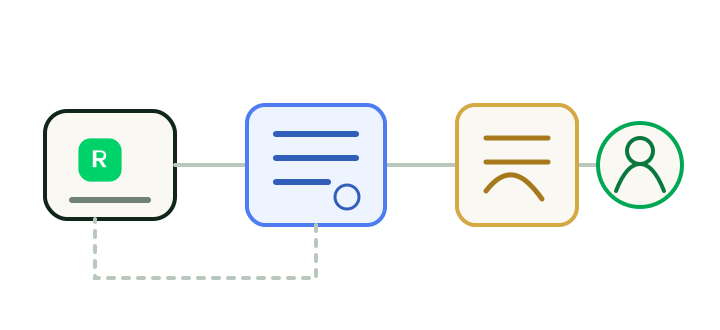
A private company. A Claimant’s Designated Representative is a business that files unclaimed-property claims on someone’s behalf. It is not part of the State.
- 2
Registered with the Department. Georgia keeps a record of who is registered to do this work, and each registration has a number you can look up.
- 3
Authorised by you, per claim. Registration alone permits nothing. A representative can only act on a specific claim you have signed for.
- 4
Registration is not endorsement. It does not mean the State vouches for the company, and it does not verify that any particular record is yours.
- 5
You can always do it yourself. Filing directly with the Department of Revenue is free and always available to you.
A Claimant Designated Representative, or CDR, is a person or company registered with the Georgia Department of Revenue to help claimants recover unclaimed property. Georgia regulates CDRs with fee caps and a ban on upfront charges — and you can verify any company’s registration with one phone call. You never need a CDR to claim your own property; filing directly with the state is always free.
At a glance
- What a CDR is
- A recovery representative registered with the Georgia DOR
- Legal fee cap
- 30% of the amount recovered (O.C.G.A. §44-12-224); 10% on bank deposits (§7-1-359)
- Upfront fees
- Prohibited — a CDR may only be paid from money actually recovered
- How to verify one
- Call the Georgia DOR Unclaimed Property line: (855) 329-9863
- Do you need one?
- No — claiming directly with the state is always free
What a CDR is — and why Georgia regulates them
Georgia holds over $3.3 billion in unclaimed property — dormant bank accounts, uncashed paychecks, insurance benefits, deposits, stocks. Wherever that much money sits, companies appear offering to recover it for a cut. Some are professional and honest. Some charge outrageous percentages for filling out a form. Some are outright scams.
Georgia’s answer is the CDR framework: to represent claimants before the Department of Revenue, a recovery firm must register with the state. Registration puts the company on record with the DOR and subjects it to the fee caps and conduct rules below. An unregistered operator asking to handle your Georgia claim is a red flag by itself.
The fee caps: 30% general, 10% on bank deposits
Georgia law sets hard ceilings on what a CDR can charge:
| Property type | Maximum legal fee | Statute |
|---|---|---|
| Most unclaimed property | 30% of the amount recovered | O.C.G.A. §44-12-224 |
| Bank / financial-institution deposits | 10% of the amount recovered | O.C.G.A. §7-1-359 |
Two things to keep in mind. First, these are caps, not standard rates — a company charging the full 30% is charging the legal maximum, and you’re free to negotiate or walk away. Second, any fee above the cap is illegal, full stop. If an agreement quotes 35%, or 20% on a bank account, the company either doesn’t know Georgia law or is ignoring it.
The no-upfront-fee rule
A CDR may not charge you anything before your money is recovered. No “processing fee,” no “document fee,” no “filing deposit.” The fee comes out of the recovery, or there is no fee. This rule does most of the work of protecting claimants: a scammer’s business model usually depends on collecting money up front and disappearing, which the CDR framework makes illegal.
Anyone who asks you to pay before you’ve received anything is not operating as a legitimate Georgia CDR — see our guide on how to spot an unclaimed property scam.
How to verify a CDR before you sign
Before signing anything with a recovery company, spend five minutes checking:
- Call the Georgia DOR Unclaimed Property line at (855) 329-9863 and ask whether the company is a registered Claimant Designated Representative. A legitimate firm will hand you its registration number without hesitation — ours is #202400088.
- Read the agreement for the fee terms. The fee should be stated as a clear percentage of the amount recovered, at or under the legal caps, with nothing due upfront and nothing owed if the recovery fails.
- Confirm the company acknowledges the free option. An honest CDR will tell you plainly that you can file directly with the state for free at gaclaims.unclaimedproperty.com. A company that hides this is telling you something about how it does business.
- Check who gets paid. In a properly structured claim, the state pays you directly — be wary of any arrangement that routes your entire payout through the company’s account first.
When hiring a CDR makes sense (and when it doesn’t)
Honest answer: a simple claim rarely needs one. If the property is in your own name, at an address you can document, and you’re comfortable gathering a signed claim form, a notarized signature, your government ID, and proof of address, you can file free with the state and typically be paid in 30–90 days. Our free step-by-step guide covers the whole process if you’d rather file yourself.
Where a CDR genuinely earns its fee:
- Heir claims — death certificates, proof of relationship, probate documents, and multiple heirs who all need to sign. These take longer and fail more often on documentation.
- Business claims — especially for dissolved or renamed companies, where proving authority to claim is its own project.
- Multi-property situations — several records under different name variations or old addresses, each needing its own evidence.
- People who simply don’t want the paperwork — a legitimate contingency fee buys a done-for-you process with no risk of paying for a failed claim.
Our registration
Reclaim Georgia LLC is Georgia CDR #202400088, valid through 2030. Most Georgia recovery firms charge the full 30 percent the law allows under O.C.G.A. §44-12-224. We run leaner with unique systems we built ourselves. We charge half — a 15% contingency — with no upfront fees, no fee if we don’t recover anything, and the state pays you directly. You can verify our registration yourself by calling the DOR line above, and our full registration details are on our credentials page. How the full service works: our process, step by step.
Start with the free search
Before deciding whether you need help, see what’s actually there. Search Georgia’s unclaimed property database free — no account, no obligation, about two minutes.